
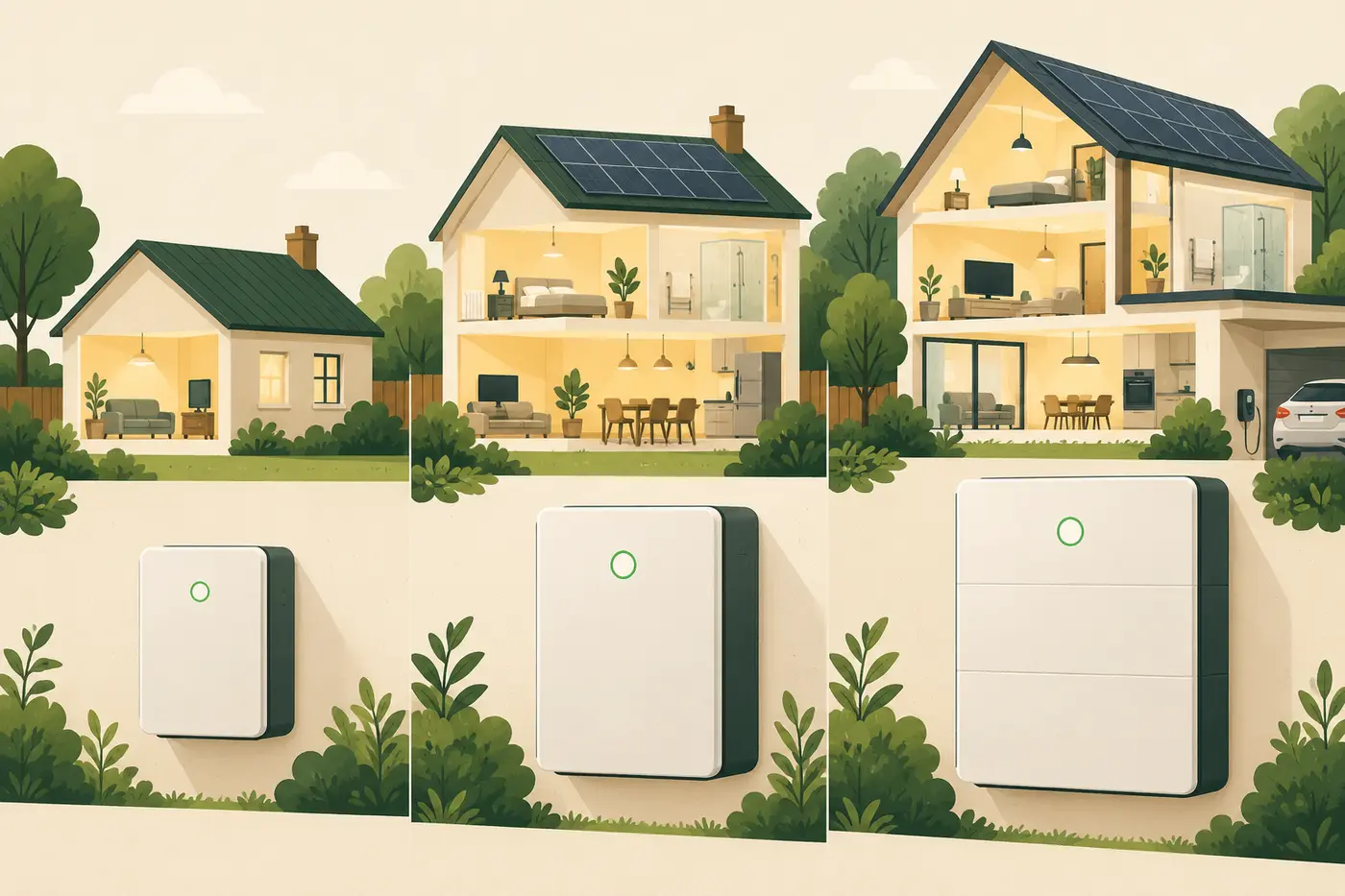
Capacity should follow the energy available to move rather than the amount a product brochure promotes. Energy Saving Trust’s broad £5,000–£8,000 storage range shows why oversizing matters: an expensive extra module cannot recover its cost while it sits empty or full. Work from measured evening demand, seasonal solar export and the off-peak window, then check how reserve settings and conversion losses reduce delivered energy.
Begin with at least a month of smart-meter data and preferably a full year. Separate daytime demand, evening demand, overnight baseload, solar export and seasonal changes. A single annual total hides the exact hours a battery is meant to move.
Capacity is energy; power is speed. A 5 kWh battery with 2.5 kW continuous output can theoretically deliver two hours at full output, but it cannot necessarily support a 7 kW shower. Decide whether the goal is bill shifting, solar capture or outage resilience before comparing products.
Leave room for real operating constraints. The app may protect a reserve, the battery loses energy during charging and discharge, and usable capacity may decline with age. Oversizing to compensate for every uncertainty usually creates more idle capacity rather than more value.
What changes the answer
Evening demand
Add the half-hourly consumption from solar fade to the start of the cheap tariff window. Use median and high-demand days rather than choosing one exceptional evening.
Solar export
Measure export during months when charging is expected. A large summer surplus cannot prove the battery will fill during winter.
Off-peak window
Multiply charge power by the cheap-window duration, then allow for losses and any simultaneous household load. This caps grid-charging potential.
Reserve requirement
Backup reserves reduce the usable energy available for daily bill optimisation. Compare products at the reserve you intend to keep.
High-power loads
Heat pumps, EV chargers and cooking appliances may exceed battery power even when capacity remains. Ask how grid import will blend with battery output.
Expansion plan
Modular expansion can reduce initial oversizing, but confirm future module compatibility, labour, firmware and warranty conditions in writing.
Illustrative worked example
Illustrative example — a Bristol semi uses 5.2 kWh between 4pm and midnight on a typical measured day. A product offers 5 kWh nominal but 4.5 kWh usable. After allowing an illustrative 90% delivered-energy factor, useful discharge is 4.5 × 0.90 = 4.05 kWh. It covers about 4.05 ÷ 5.2 = 78% of that evening demand. Applying Ofgem’s 26.32p average rate to 4.05 kWh is worth at most 4.05 × £0.2632 = £1.07 that day before charging cost or lost export. This supports testing one module before buying two.
Rules and responsibilities for this topic
Connection route
The combined export capability of battery and solar inverters determines the network application, not battery capacity alone.
Location assessment
The designer should follow manufacturer limits for temperature, clearances and enclosure protection and should assess escape routes and impact risks.
Handover information
Keep single-line diagrams, settings, shutdown instructions, warranty registration and the DNO response with the property records.
Turn meter data into a sensible capacity
Download at least a month of half-hourly readings and, where possible, a full year. For each day, total consumption from late afternoon until the cheap overnight period begins. Then calculate the median rather than selecting the household’s single busiest evening. If solar is already installed, total midday export separately by season. The smaller of repeatable surplus and later demand is a useful starting point for storage; bedroom count and annual consumption are too blunt to size a battery.
Convert nominal capacity into energy that can actually be delivered. Deduct the intended backup reserve and allow for charge and discharge losses. Next check power: a unit may store enough energy for an evening yet still import from the grid when cooking, heating or vehicle loads exceed its continuous output. Grid-charging designs also need enough inverter power and off-peak hours to refill before the expensive period. Ask the designer to show these constraints on an ordinary winter day and a high-demand day.
Price one module, the recommended arrangement and the next larger option using identical tariff assumptions. The marginal module should justify its own cost through additional shifted energy rather than improving the headline self-sufficiency percentage. If expansion is proposed, confirm compatible modules will remain available, whether mixed-age packs are allowed and how another module affects network paperwork and warranty cover. Record usable capacity at your chosen reserve in the contract. The battery comparison tool helps compare that figure with continuous output and warranty limits.
Use percentiles to expose oversizing. If a proposed unit can absorb the available surplus on only a handful of exceptional days, calculate how often the extra capacity will earn anything. A smaller battery that completes frequent cycles can deliver more useful throughput per pound spent. Conversely, a home with a long off-peak window and consistent evening demand may justify additional storage even without solar. Ask the designer to show annual energy moved by each candidate size, not simply the percentage of consumption labelled self-sufficient.
Questions to ask the installer
- Which smart-meter period did you use to size capacity?
- Is the quoted figure nominal capacity or usable capacity?
- How much energy remains after my chosen backup reserve?
- Can the battery fully charge inside my cheap-rate window?
- What is continuous output at my operating temperature?
- Can another module be added later without replacing equipment?
A sizing recommendation is credible only when the installer shows the meter data behind it.
Frequently asked questions
How many kWh should my battery be?
There is no bedroom-based answer. Calculate repeatable evening demand, solar export and cheap-rate charging opportunity. A household with 4–5 kWh of shiftable demand may obtain more use from a roughly comparable usable capacity than from a much larger unit that often remains partly empty.
What is usable battery capacity?
Usable capacity is the energy the control system allows you to cycle. Nominal capacity includes energy held outside the normal operating range. Compare usable figures at the proposed reserve setting and ask whether the warranty assumes a particular depth of discharge.
Should battery capacity match solar size?
Not directly. Solar is rated in kWp while batteries store kWh, and generation varies by hour and season. Size storage from measured surplus and later demand. A large array can still have little winter surplus, while a smaller array may export heavily on sunny days.
Can I start small and expand later?
Some modular systems allow this, but compatibility is product-specific. Ask how long matching modules will remain available, whether modules of different ages can mix, whether a new network application is needed and how the warranty applies after expansion. A sizing recommendation is credible only when the installer shows the meter data behind it.
Does a bigger battery give better backup?
It can extend runtime, but only if the backup output and circuit design support the loads. Capacity determines duration; power determines which appliances can run together. A smaller high-output system may handle a kettle more readily than a larger low-output design.
Independent sources
- Energy Saving Trust, Energy storage options (accessed 3 October 2026)
- Energy Saving Trust, Solar panels and battery storage (accessed 3 October 2026)
- Energy Networks Association, Connecting generation (accessed 3 October 2026)
- Ofgem, Price-cap unit rates (accessed 3 October 2026)
Last updated .